Osaka, Kyoto and Nara with friends: a Kansai trip from Singapore
Fly into Kansai, eat your way down Dotonbori, climb through Fushimi Inari's torii at dawn and feed the deer in Nara. A group itinerary from Singapore that works for the 25-year-olds and the 50-year-olds.
By Onz Editorial · edited by Shawn Liu · 23 November 2026
Ask any group chat where to go first in Japan and someone will say Osaka. Fair enough. Kansai gives you three very different cities within an hour of each other: Osaka for neon, street food and late nights, Kyoto for temples and lantern-lit lanes, and Nara for a park full of free-roaming deer and one very large Buddha.
Getting-there and entry details checked 23 Nov 2026.
Party people get Dotonbori; slow-morning people get Kiyomizu-dera's wooden stage; everyone gets fed, constantly.
The vibe: neon canal nights in Osaka, a dawn hike through thousands of orange gates in Kyoto, and a deer day out in Nara.
Know this first: do your Visit Japan Web before you fly 📲
Singapore passport holders don't need a visa for short visits; Singapore MFA's travel page says no visa is required for short-term stays in Japan of less than 90 days. What you do need, if you don't want to spend your first hour in a queue, is Visit Japan Web, the Japanese government's online form for immigration and customs.
Register before you leave home, fill in your arrival details, and it generates QR codes. Japan Customs recommends declaring online this way, and its Kansai Airport Terminal 1 guide is clear that every member of a family or group needs their own code, so don't let one person do it for the whole squad. Screenshot your code; Customs says the screenshot works offline.
JESTA, the new one people are asking about: Japan passed a law in May 2026 (promulgated 5 June 2026) creating JESTA, an online pre-travel authorisation for visa-free visitors, similar in spirit to the US ESTA. It is not in force yet. The Immigration Services Agency says the JESTA provisions take effect on a date set by government ordinance, no later than 31 March 2029, with a target of fiscal year 2028. Once it starts, travellers without one generally won't be allowed to board. For 2026 or 2027 trips, you don't need it.
Two more 2026 changes: Japan's international tourist tax (the departure tax baked into your air ticket) tripled for departures from 1 July 2026, according to the Japan Tourism Agency. And from 1 November 2026, tax-free shopping switched to a refund method: you now pay the full price including consumption tax in the shop, and the tax is refunded only after Customs confirms at departure that you're taking the goods out of Japan.
Safety: Singapore MFA has no travel advisory for Japan, only its standard travel page. It suggests eRegistering your trip and recommends the NHK World app for English earthquake and tsunami alerts.
Getting there ✈️
Flights: Singapore Airlines and Scoot both fly nonstop from Changi to Kansai International Airport (KIX), which sits on an island in Osaka Bay. Singapore Airlines lists the flight at roughly six hours twenty to six hours thirty minutes; Scoot says about six hours forty-five and leaves from Changi Terminal 1. Pick an overnight departure and you land with a full first day ahead of you. Check current fares when you book.
KIX to Osaka: Nankai's Limited Express rapi:t reaches Namba in as little as 34 minutes and needs a limited express ticket on top of the normal fare. The Nankai Airport Express takes about 45 minutes on a regular ticket.
KIX to Kyoto: JR West's Haruka limited express runs direct to Kyoto Station in about 75 minutes, stopping only at Tennoji, Osaka (Umeda) and Shin-Osaka. Reserved seats aren't compulsory, but a group with suitcases will want to sit together, so book them.
Between the cities: Kintetsu runs from Kyoto Station to Kintetsu-Nara in about 34 minutes by limited express (extra ticket needed), and from Osaka-Namba to Kintetsu-Nara in about 34 minutes by express. Visit Nara says Nara Park is a five-minute walk from Kintetsu-Nara Station, versus about 15 minutes from JR Nara.
A 3-day squad plan 🗓️
This assumes you land on a morning flight, base yourselves in Osaka (Namba or Umeda), and fly home on day four. If your group would rather wake up in Kyoto, flip days one and two and take the Haruka straight there.
Day 1: Osaka, mouth first. Land, ride the rapi:t to Namba, dump the bags and walk to Kuromon Market for a grazing lunch of grilled seafood and fruit. Afternoon: Osaka Castle park for the main keep and the stone walls, or a nap if you took the red-eye. At dusk head to Dotonbori for the neon, then take the 20-minute Tombori River Cruise past the Glico running man. Night owls carry on in the side streets; the slower crew can call it after dinner.
Day 2: Kyoto, temples and lanterns. Start early. JR's Nara Line gets you from Kyoto Station to Fushimi Inari Taisha in about nine minutes; Kyoto's tourism site says the torii are at their most striking at dawn, before the tour groups. Then cross town to Kiyomizu-dera and its wooden stage over the trees. Lunch at Nishiki Market, standing at the stall (more on that below). Late afternoon, wander Gion as the lanterns come on, quietly. JR back to Osaka.
Day 3: Nara, deer and the Big Buddha. From Namba, Kintetsu gets you to Kintetsu-Nara in about 34 minutes. Walk five minutes and you're in Nara Park, roughly eight square kilometres home to almost 1,200 deer, according to Visit Nara. Buy the shika senbei deer crackers sold around the park and brace yourselves. Then Todai-ji: the Great Buddha Hall opens 8am to 5pm from November to March and 7:30am to 5:30pm from April to October. Back in Osaka by late afternoon for a last big dinner.
Swap-outs: younger groups can trade Day 1's castle or a Kyoto afternoon for a full day at Universal Studios Japan. Groups who've done Fushimi Inari before can do Arashiyama instead, going early and taking the quieter route through Kameyama Park to the bamboo grove, as Kyoto's tourism site recommends.
Things to do 🎌
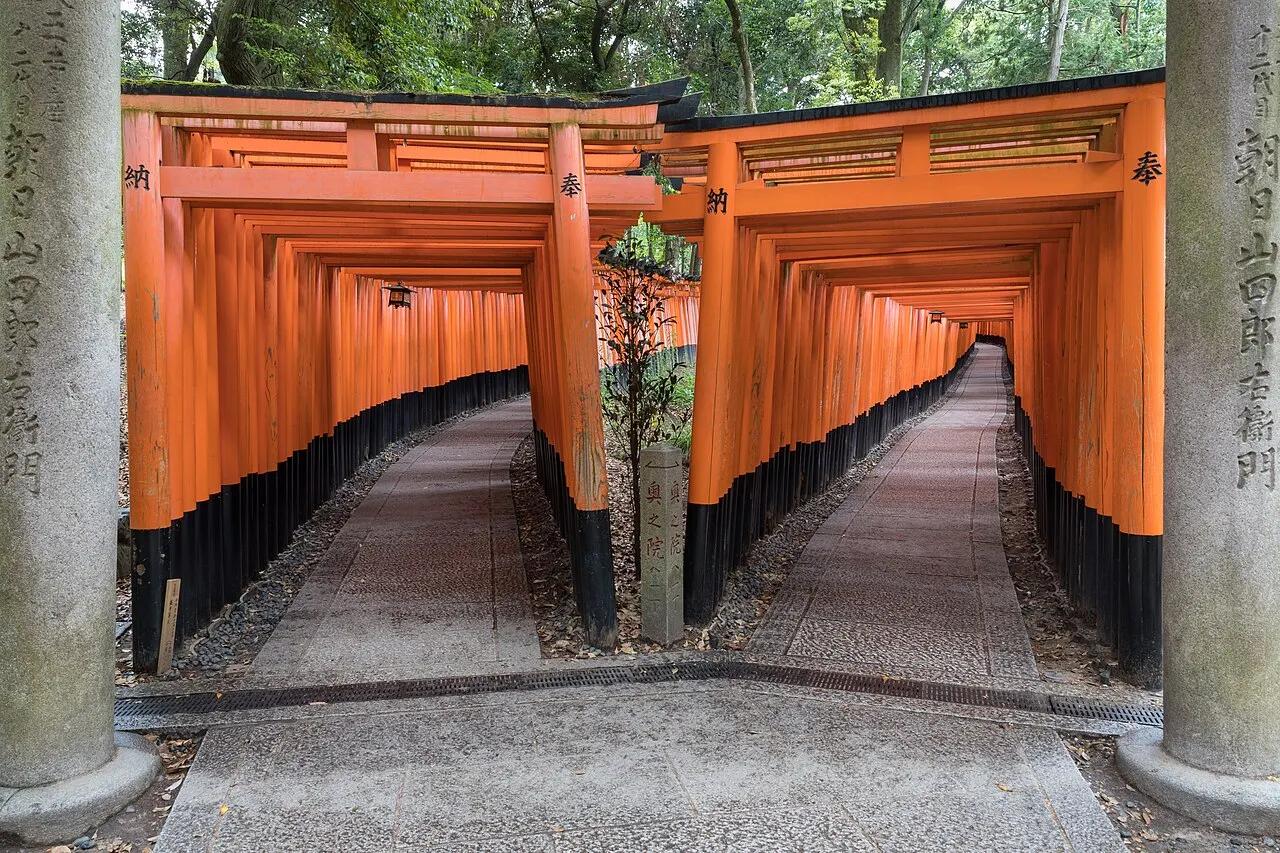
Climb Fushimi Inari's torii tunnels. Thousands of orange gates line the path up Inariyama, a 233-metre holy mountain behind the shrine. The lower stretch of gates is where everyone stops for photos; keep climbing if you want quieter paths. Agree on a meeting point at the bottom; a group of six will split by the second fork.
Stand on Kiyomizu-dera's stage. The temple's famous wooden platform hangs off the hillside with all of Kyoto spread out below. It opens at 6am, which is the time to go. Its 2026 autumn night viewing runs 21 to 30 November until 9:30pm (last entry 9pm), with no reservation needed, so if you're reading this in time, go after dark.
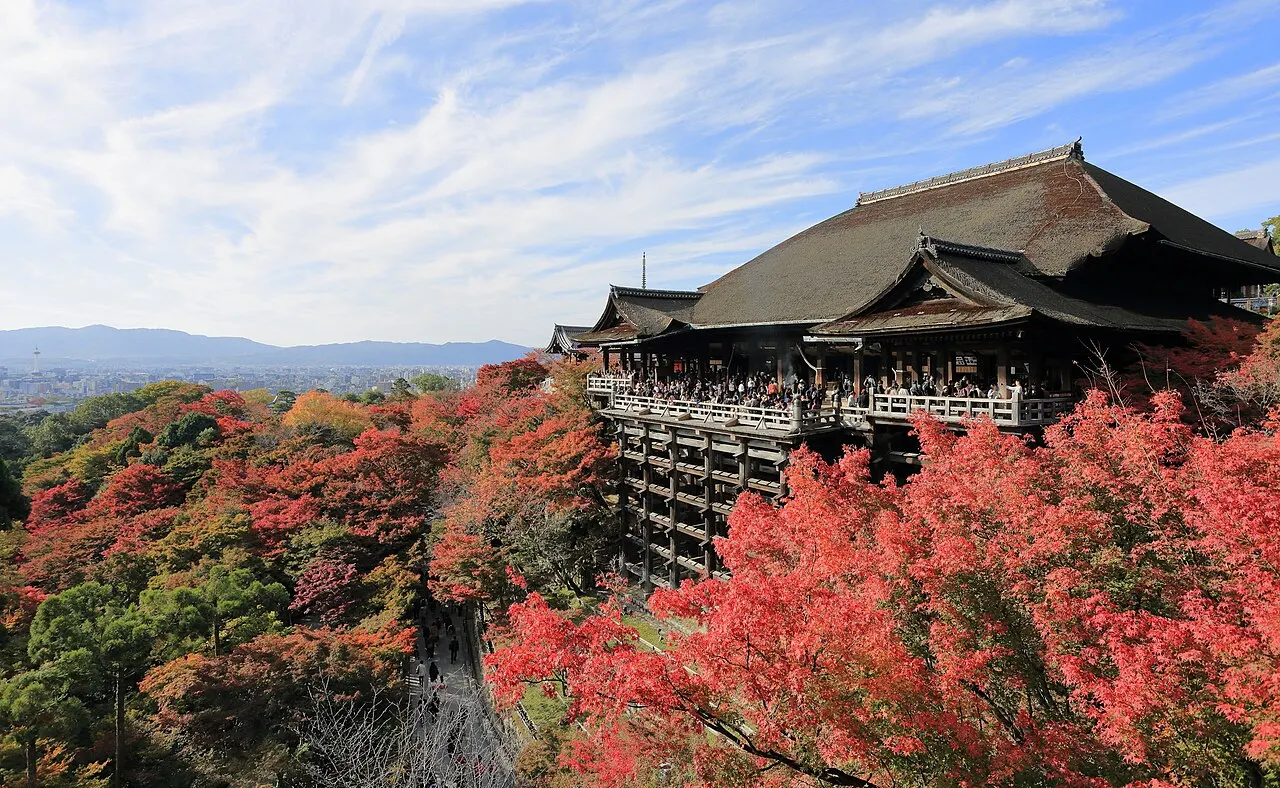
Photo: Martin Falbisoner (CC BY-SA 4.0), Wikimedia Commons
Do Dotonbori properly at night. The canal is Osaka's postcard: walls of signboards, the Glico sign and food shopfronts that stay lit long after dark. The Tombori River Cruise boards at Tazaemonbashi Pier, takes about 20 minutes with a guide pointing out the sights, and can be booked online up to ten minutes before departure.
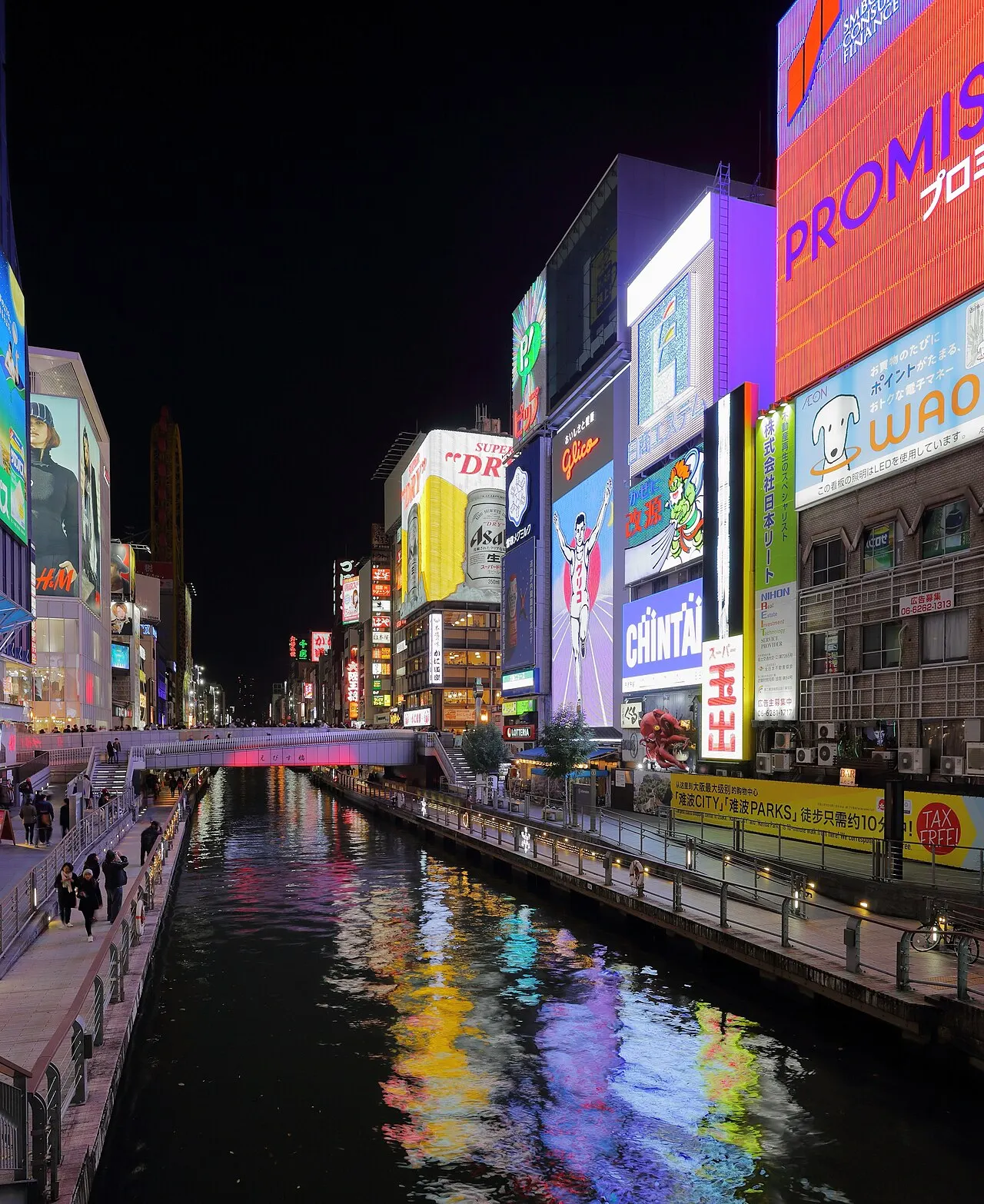
Photo: Martin Falbisoner (CC BY-SA 4.0), Wikimedia Commons
Meet the deer in Nara. Nara's deer are wild, protected and very interested in your snacks. Visit Nara says the official shika senbei crackers are the only food you should give them; deer have died from swallowing plastic and other rubbish. When you run out, show your empty hands and they'll move on. Keep a close eye on small kids, as the deer get pushy.
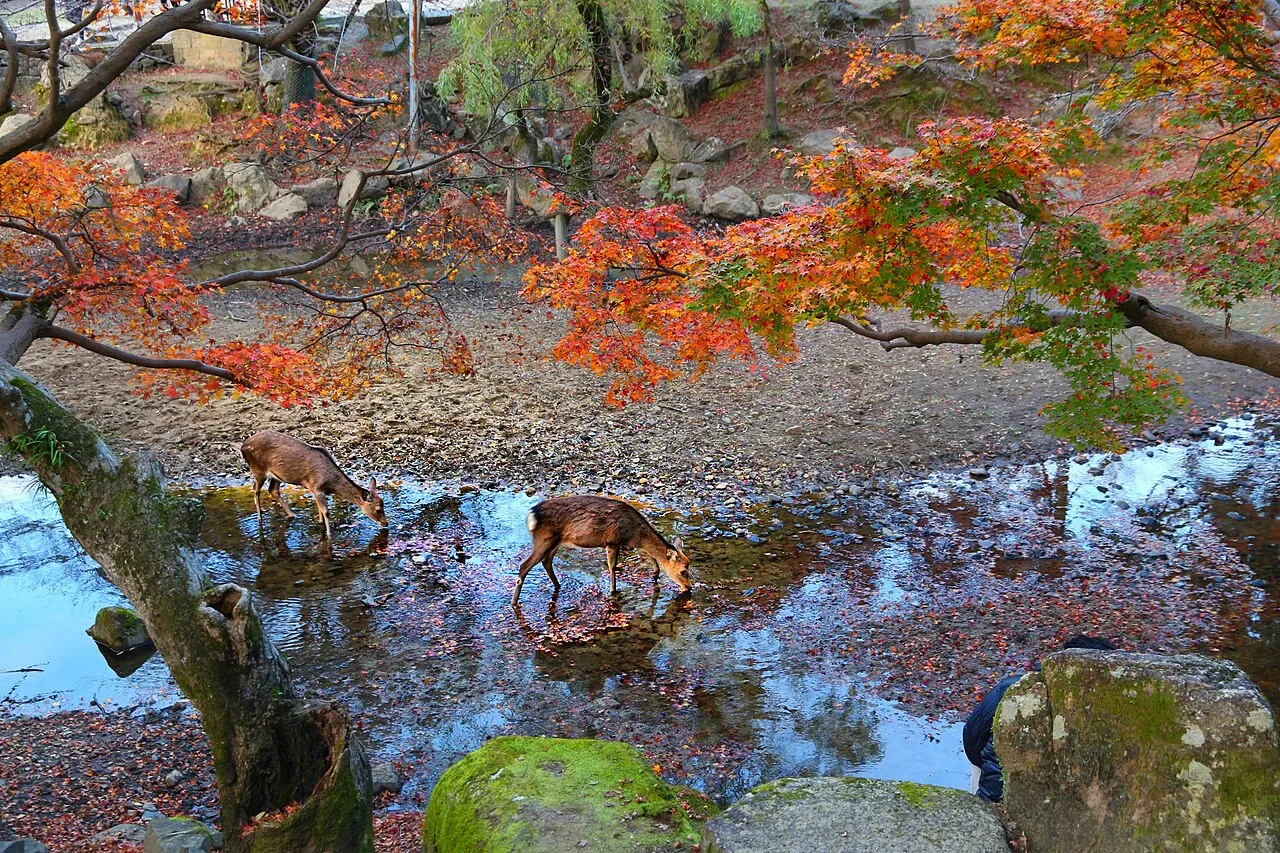
Photo: Marek Ślusarczyk (Tupungato) Photo portfolio (CC BY 3.0), Wikimedia Commons
See the Great Buddha at Todai-ji. The Daibutsu-den, or Great Buddha Hall, is the big one in Nara Park and it's open all year. Pair it with the deer and you've done Nara's big two in a morning.
Spend a day at Universal Studios Japan. Super Nintendo World is the draw for the under-35s. Since 5 January 2026, USJ says you need its official app to get the Area Timed Entry and Standby Entry tickets inside the park, after registering your park ticket in it. Standby tickets are a lottery and must be requested at least an hour before your slot. If the group wants certainty, some Express Passes bundle a timed entry; Express Passes are only valid for the date bought and for the named purchaser.
Walk Arashiyama's bamboo grove. Tall, green and hushed, if you get there early. Togetsukyo Bridge is about a four-minute walk from Keifuku Arashiyama Station, and you can stroll along the river from Tenryu-ji to the bridge.
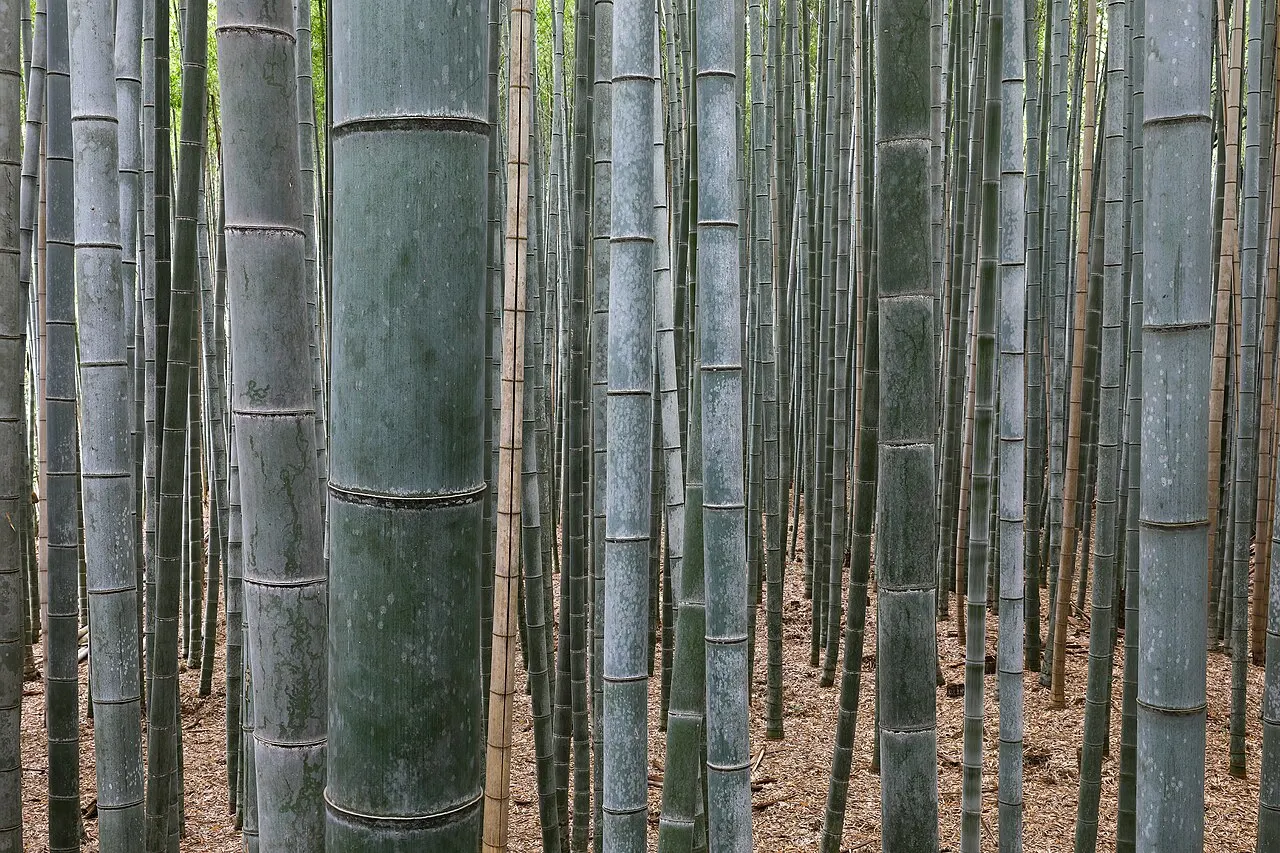
Photo: Basile Morin (CC BY-SA 4.0), Wikimedia Commons
Markets to graze 🛍️
Kuromon Market, Osaka. Osaka's best-known food market, packed with seafood counters, fruit stalls and eat-in shops. There's no single opening time: each shop sets its own hours, some open early for fish and some close on Sundays or holidays. The market's own information centre runs 9am to 6pm. Go for lunch rather than dinner.
Nishiki Market, Kyoto. A long market street of pickles, sweets, knives and grilled skewers in central Kyoto. Hours vary by shop, but on the market association's site most open around 10am and many close between 4pm and 6pm; Wednesday and Sunday are common rest days for individual shops. Kyoto's tourism site says eating or drinking while walking is strictly prohibited here, so eat at the stall.
Kobo-san flea market at To-ji, Kyoto (21st of every month). A huge market fills the temple grounds on the 21st, with antiques, ceramics, old kimono and food stalls. The next ones fall on Monday 21 December 2026 and Thursday 21 January 2027. It may be cancelled in rain; check exact hours before you go.
Tenjin-san flea market at Kitano Tenmangu, Kyoto (25th of every month). Kyoto's tourism site lists it from 7am to 4pm. The next one lands on Friday 25 December 2026, then Monday 25 January 2027. Same rain caveat.
For the 'gram 📸
Fushimi Inari Senbon Torii · Fushimi, Kyoto. The double row of gates where the path splits in two. Best just after sunrise, before the crowds turn your shot into a queue.
Glico sign from Ebisu Bridge · Dotonbori, Osaka. Do the running-man pose with the whole group. Best after dark, when the canal reflects the neon.
Kiyomizu-dera's stage from below · Higashiyama, Kyoto. The whole wooden frame rising out of the maples. Best at opening time, or during autumn night viewing.
Umeda Sky Building's Kuchu Teien observatory · Umeda, Osaka. A rooftop ring linking two towers, with views across the city. Best at sunset into night; check the official site for current hours.
Deer under the maples · Nara Park. Low angles, soft light, one person on cracker duty. Best in the morning.
Squad tip 👯
Pick one base. For three nights, a single Osaka base (Namba for nightlife and the rapi:t, Umeda for JR connections) saves you from packing and unpacking. Apartments and family rooms in Osaka help groups of four to six stay together. If you do stay in Kyoto, its accommodation tax went up on 1 March 2026; it's charged per person per night, it rises with the room rate, and you usually pay it at the hotel.
Travel light into Kyoto. Kyoto's tourism office asks visitors to leave luggage before sightseeing, and promotes its Hands Free Kyoto service for storage and delivery.
Everyone gets their own IC card. ICOCA cards are sold at the JR and Nankai stations at Kansai Airport, and JR West says iPhone users can add ICOCA to Apple Wallet.
Book ahead: USJ tickets, Haruka or rapi:t seats if you're arriving at peak times, Kintetsu limited express seats, and any dinner for six on a Friday or Saturday night. Big groups are hard to seat on walk-in, so chope a table early.
Money and data: run a kitty for food and split the rest at the end of the day. Sort an eSIM or a pocket Wi-Fi before you fly so the group map and the train apps work from the gate.
Taxis: for four, a taxi can be simpler than a bus. Kyoto warns against white-plate private cars touting rides at airports and sights; use green-plate licensed taxis or official ride-hailing apps.
Don't be that guy 🙅
Smoking on the street in Osaka. Osaka City has banned street smoking across the whole city since 27 January 2025, covering heated tobacco too, and patrols issue on-the-spot fines. Use the designated smoking booths.
Chasing maiko in Gion. Kyoto's tourism site and Gion residents say stopping geiko or maiko for photos, following them or photographing them without permission is prohibited. Don't wander onto private property, don't use tripods for street shots, don't touch tea-house lanterns, and don't walk six abreast down lanes that are also roads.
Carving your name into bamboo. Kyoto says carving the bamboo in Arashiyama or at Fushimi Inari is a criminal offence with heavy fines. Also: never step onto the train tracks in Arashiyama.
Littering and droning. Kyoto has 43 beautification promotion areas, Arashiyama included, where littering can be fined, and flying drones is prohibited over most of the city. Bins are rare, so carry a bag for your rubbish.
Feeding the deer your snacks. Only the official shika senbei. No chips, no bread, no plastic wrappers left lying around.
Stuffing your tax-free shopping into checked luggage. Under the refund method that started on 1 November 2026, Customs has to confirm the goods at departure, within 90 days of purchase. Do it before you check in, keep those items accessible, and leave plenty of time before your flight. Don't eat or use consumables you're claiming a refund on.
Following touts. Singapore MFA warns of foreigners being targeted for credit card fraud and extortion in nightlife districts, and advises avoiding touts. In Dotonbori too, choose your own bar.
Driving on a whim. MFA says you need an original International Driving Permit to drive in Japan; rental companies won't rent to you without one. And the legal age for drinking is 20, so the 18- and 19-year-olds in the group are on soft drinks.
When to go 🌤️
Spring (late March to early April): cherry blossoms reach Osaka and Kyoto in early April, according to JNTO, though timing is hard to predict. Gorgeous, and very busy; book everything early.
Autumn (late November to early December): JNTO describes autumn as one of Japan's most comfortable seasons, and its 2026 forecast puts Osaka's peak leaves in early December. Our pick for a group: cooler days, red maples at Kiyomizu-dera and Nara Park, and night illuminations.
Summer (June to September): JNTO says the rainy season starts in May to June, summer is stiflingly hot and humid, and August and September may bring typhoons.
Winter (December to February): cold, but JNTO notes many sunny days. Note Osaka Castle's museum closes over the New Year break, and plenty of shops take time off around then too.
Our pick: a four-night trip in late November or early December, Osaka base, one Kyoto day, one Nara day, and a red-eye home. Hours shift by season, so check before you go.
Before you go
We checked this guide against official sources on 23 Nov 2026, but entry rules, schedules, opening hours and park or operator policies change, sometimes without notice. Please confirm the details with the official websites, your airline and the relevant authorities (including Singapore MFA travel advice) before you book or travel. This guide is general information, not professional travel, medical or legal advice, and Onz is not responsible for changes made by third parties.
Book it
Universal Studios Japan ticket · Kansai Airport Haruka ticket · Nankai rapi:t ticket Kansai Airport to Namba · Japan eSIM
Klook links are affiliate links: Onz may earn a small commission if you book.
Questions, answered 🤔
Do Singaporeans need a visa for a group trip to Osaka and Kyoto?
No. Singapore MFA says Singapore passport holders don't need a visa for short-term visits to Japan of less than 90 days. Each person should still register on Visit Japan Web before the flight to get their own immigration and customs QR codes; Japan Customs says every member of a group needs their own code.
Do I need JESTA to visit Japan from Singapore?
Not yet. Japan's JESTA law was promulgated on 5 June 2026, but the Immigration Services Agency says the JESTA provisions start on a date set by ordinance, no later than 31 March 2029, with a target of fiscal year 2028. Until it launches, Singapore passport holders enter visa-free as before. Check the agency's site before trips from 2028.
What's a good 3-day Kansai itinerary for a group from Singapore?
Base yourselves in Osaka. Day 1: Kuromon Market, Osaka Castle and Dotonbori at night. Day 2: Kyoto, with Fushimi Inari at dawn, Kiyomizu-dera, Nishiki Market and Gion at dusk. Day 3: Nara Park's deer and Todai-ji's Great Buddha, about 34 minutes from Namba by Kintetsu. Swap in Universal Studios Japan or Arashiyama to suit the group.
How do we get from Kansai Airport to Osaka and Kyoto?
Nankai's rapi:t runs to Namba in as little as 34 minutes (limited express ticket needed), or take the slower Airport Express on a regular ticket. JR's Haruka goes direct to Kyoto in about 75 minutes, stopping at Tennoji, Osaka and Shin-Osaka. Book reserved seats if your group wants to sit together.
Has tax-free shopping in Japan changed?
Yes. From 1 November 2026, shops charge the full tax-inclusive price, and the consumption tax is refunded after Customs confirms at departure that you're taking the goods out of Japan, within 90 days of purchase. Do the procedure before you check your bags, and don't use up consumables you're claiming on.
When is the best time for a Kansai trip with friends?
Late November to early December for autumn leaves and comfortable weather, or late March to early April for cherry blossoms, which are the busiest weeks of the year. JNTO says summer is hot and humid with a rainy season from May to June, and August and September can bring typhoons.
Is Universal Studios Japan worth a day on a group trip?
For a younger group, usually yes. Note that since 5 January 2026 USJ requires its official app for the Area Timed Entry and Standby Entry tickets for areas like Super Nintendo World, and standby tickets are a lottery. Book park tickets ahead, and consider an Express Pass that includes a timed entry if everyone must get in.
Don’t say we bojio 📬
Reads like this + the week’s best events, every Thursday.
Not an email person? Follow @onzsg on Telegram — two good picks a day, straight to your phone. 📣