
Asian Civilisations Museum ·
with the Musée du Louvre
Crosscurrents
Three empires and one interconnected world, from Istanbul and Isfahan to Delhi and Southeast Asia — shaped by trade, diplomacy, migration and artistic exchange.
19 JUNE 2026 — 24 JANUARY 2027
Pictured: an Ottoman jade cup, mid-16th century. Gold wire laid into channels cut in the stone.
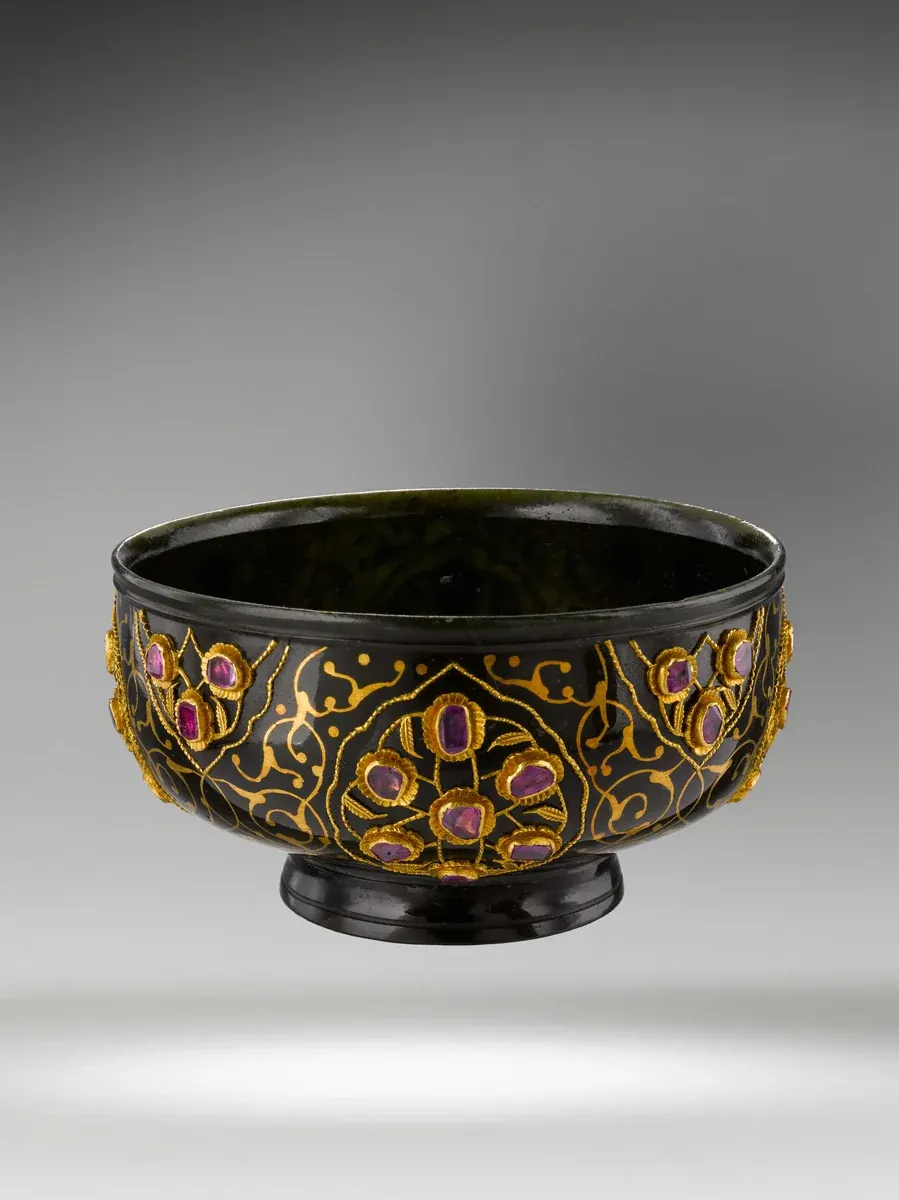
Cup. Turkey, mid-16th century. Jade, gold, rubies. Department of Islamic Art, MR 202 © 2009 Musée du Louvre, Dist. GrandPalaisRmn / Hughes Dubois
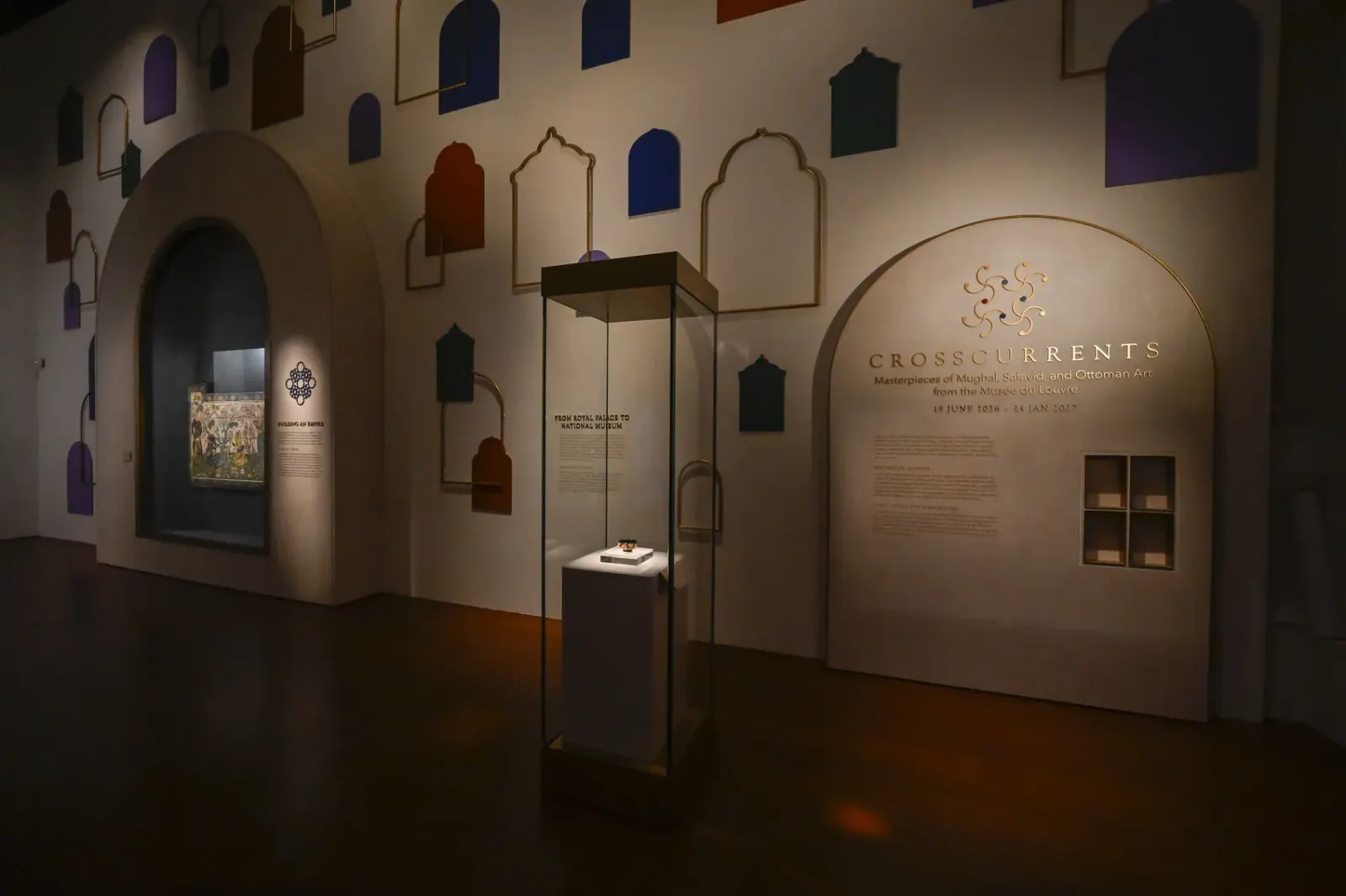
What you’re walking into
From the 16th to the 18th century, three great empires — the Mughals, Safavids and Ottomans — shaped a vast and interconnected world across Asia. This period marked the height of their influence, even as European expansion reshaped global trade and politics. Within and between these empires, artists produced works of remarkable beauty that projected authority and gave visible form to power.
The exhibition presents one hundred masterpieces from the Louvre, drawn from royal collections and later acquisitions. Southeast Asian objects from ACM’s collection are interwoven throughout, bringing these traditions into dialogue and revealing the crosscurrents that connected distant regions.
It runs across two floors: the Islamic Art Gallery on Level 2, then the Design Gallery on Level 3.
Image courtesy of Asian Civilisations Museum.
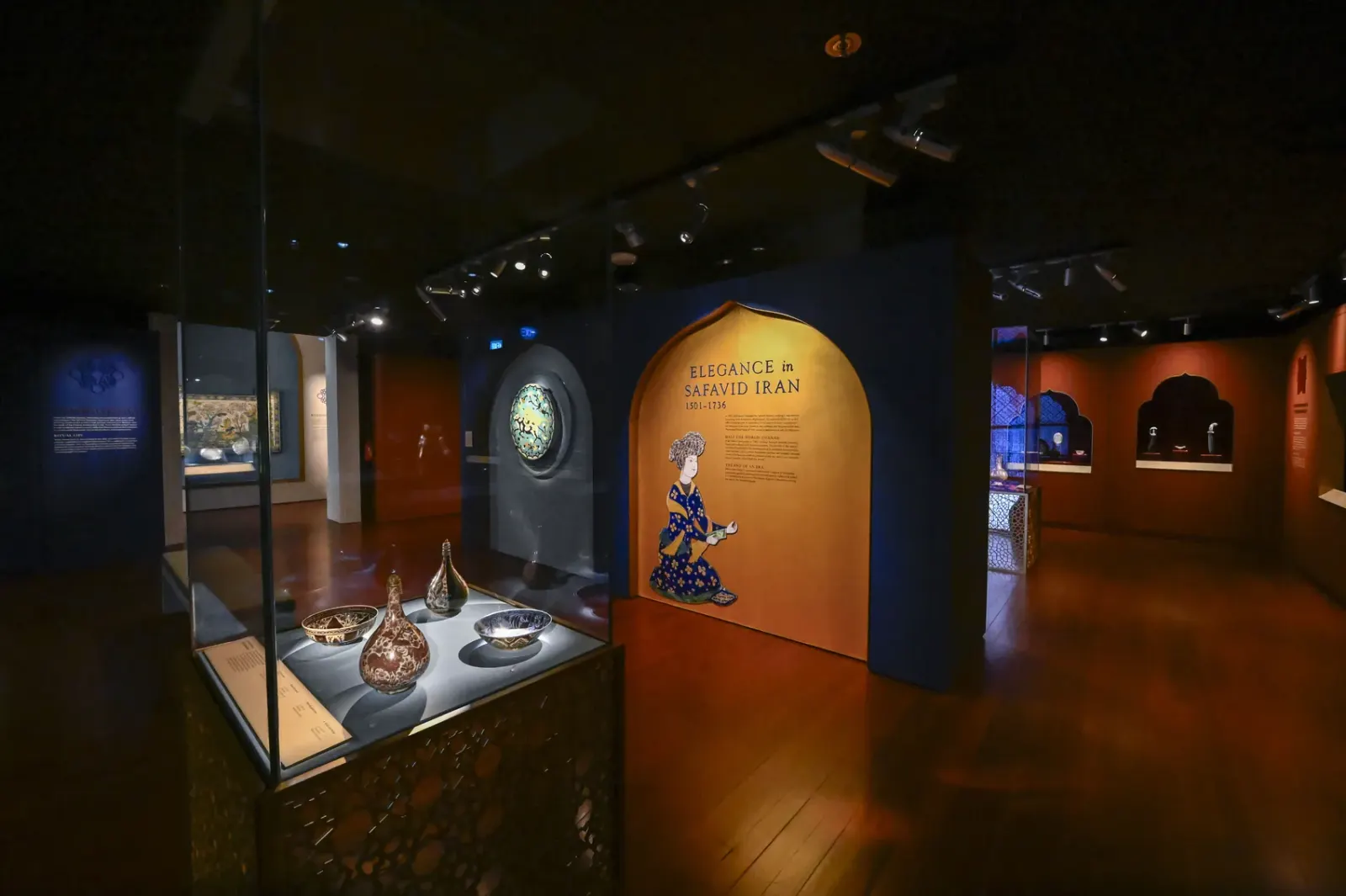
Level 2 · Islamic Art Gallery
Elegance in Safavid Iran
1501 — 1736
Courtly life and artistic production developed here alongside expanding trade routes. Persian storytelling, language and aesthetics travelled east along them.
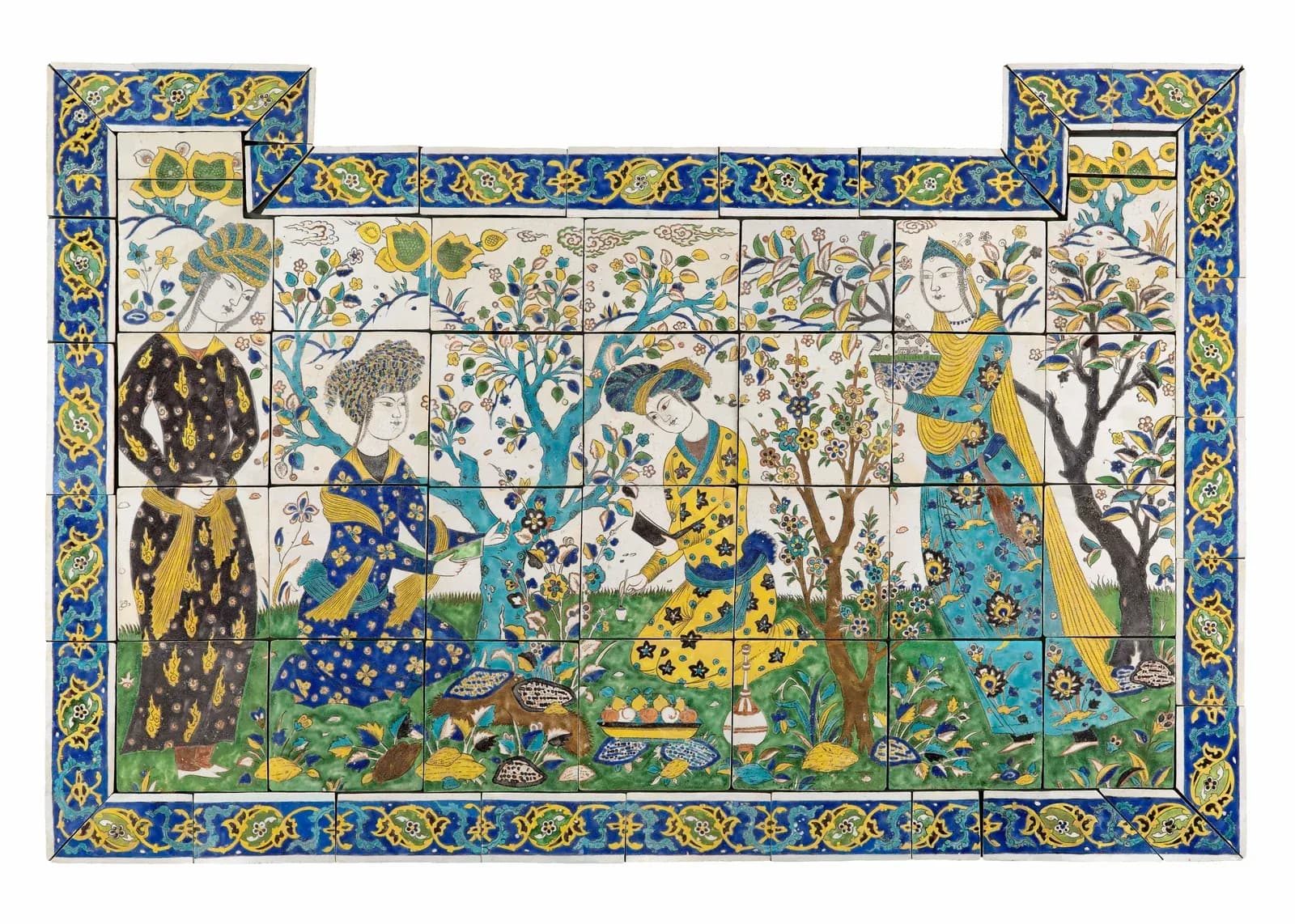
Tiled panel with poetry contest
Two young men are engaged in a poetry contest, while another records the verses in a safina, an oblong calligraphy album. Once part of a royal pavilion in Isfahan, panels like this decorated the lower walls beneath frescoes of princely entertainment and courtly life. Persian literary culture travelled too — it shaped the hikayat tradition, and contributed Persian loanwords and ideas into Malay and Siamese court culture.
Tiled panel with poetry contest. Iran, mid-17th century. Glazed ceramic. Department of Islamic Art, OA 3340 © 2012 Musée du Louvre, Dist. GrandPalaisRmn / Raphaël Chipault
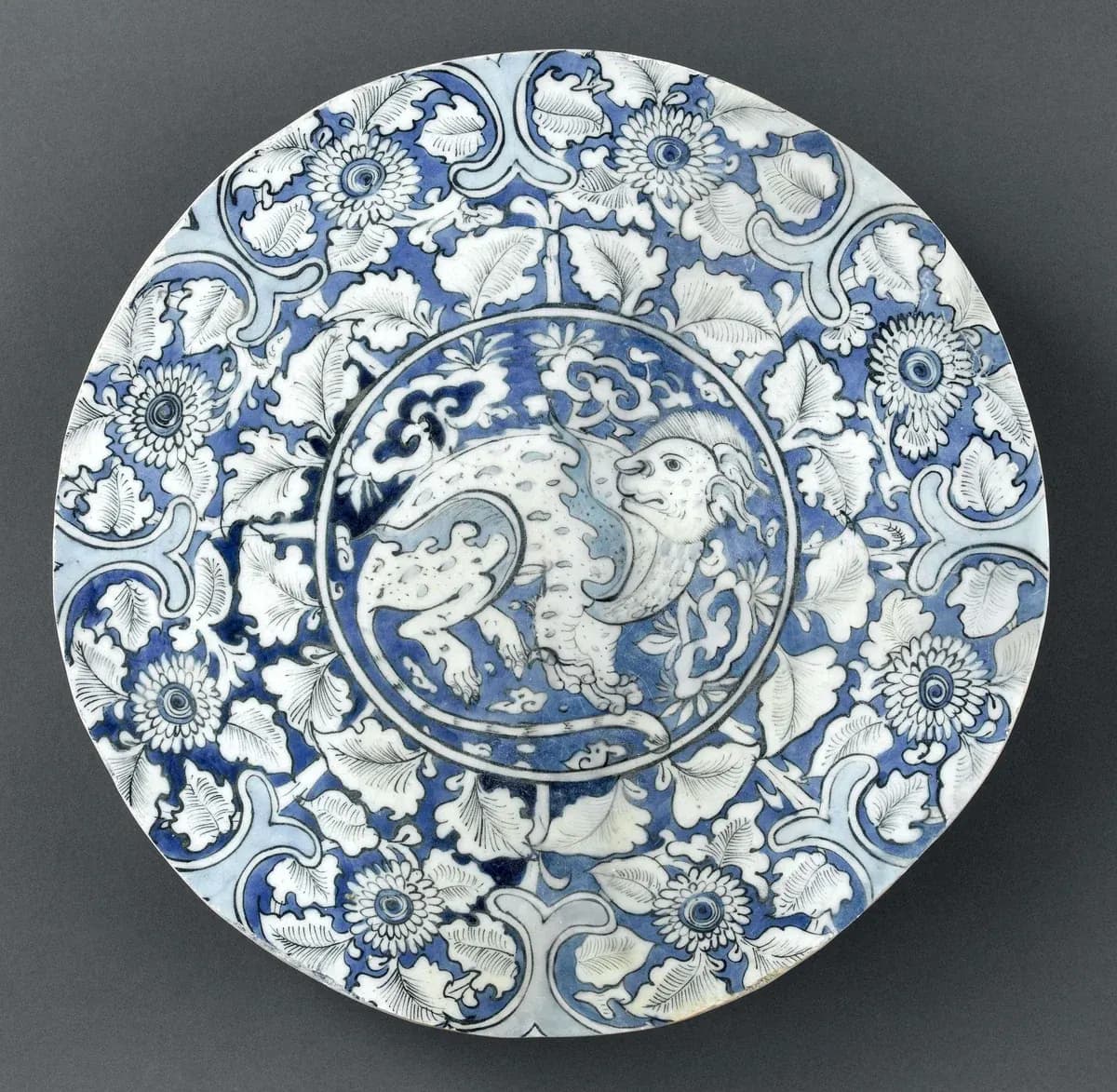
Dish base with qilin
At the centre is a Safavid interpretation of the qilin, a mythical creature from Chinese tradition. As maritime trade flourished under Shah ‘Abbas I, Chinese blue-and-white porcelain became highly prized in Iran — and Iranian potters adapted the foreign motifs into their own visual language.
Dish base with qilin. Iran, first half of the 17th century. Glazed ceramic. Department of Islamic Art, OA 5711 © 2007 Musée du Louvre, Dist. GrandPalaisRmn / Jean-Gilles Berizzi
Level 2 · Islamic Art Gallery
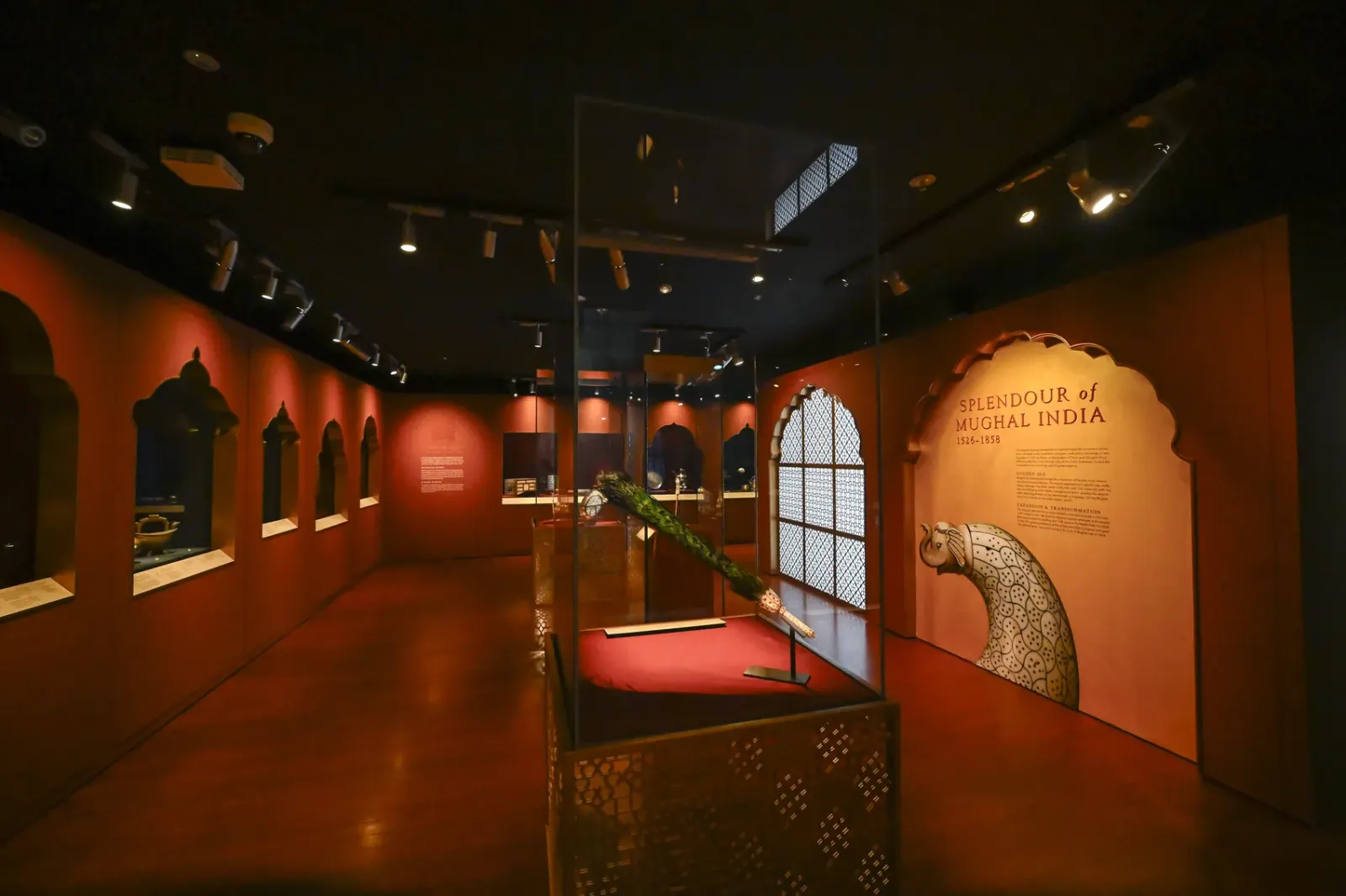
Splendour of Mughal India
1526 — 1858
The luxury arts of the Indian Ocean world — made for royal courts and elite patrons throughout Asia and Europe.

Dagger with horse-head hilt
With its rock crystal hilt shaped into the form of a horse’s head, this dagger illustrates the Mughal fascination with naturalism. Animal-head hilts became essential symbols of courtly status during the reign of Emperor Jahangir (1605–27), later appearing in royal portraits and hunting scenes. The original blade has been replaced with a narrower example, but the hilt preserves the refinement of kundan — highly purified gold securing gemstones within delicate settings, layered over floral engravings.
Dagger with horse-head hilt. India, 17th or 18th century. Rock crystal, gold, silver, rubies, emeralds. Bequest of Baroness Salomon de Rothschild, 1922. Department of Islamic Art R 162a © 2016 Musée du Louvre, Dist. GrandPalaisRmn / Hervé Lewandowski
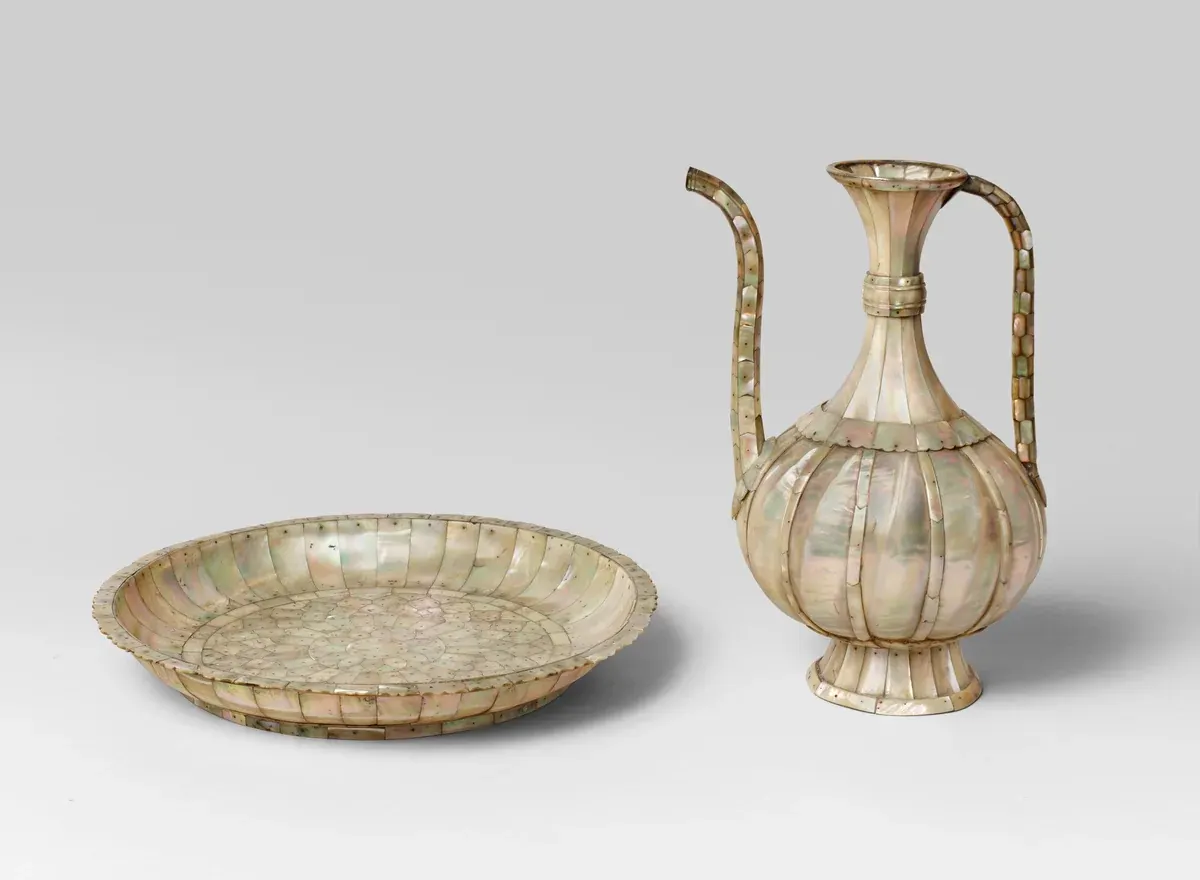
Ewer and basin
Made almost entirely of mother-of-pearl, used as both decoration and structure. Objects like these were shipped through Goa and sometimes fitted with silver mounts before being exported to Europe, the Middle East, the Ottoman Empire and the Dutch East Indies. The ewer’s distinctive Indian form, with curved spout and fluted body, suggests it may have been made for local elites — or for export to the Ottoman world.
Ewer and basin. India, around 1585 – 1615. Mother-of-pearl, metal. Department of Islamic Art, RFML.AI.2023.29.1, 2 © 2024 Musée du Louvre, Dist. GrandPalaisRmn / Hervé Lewandowski
Level 3 · Design Gallery
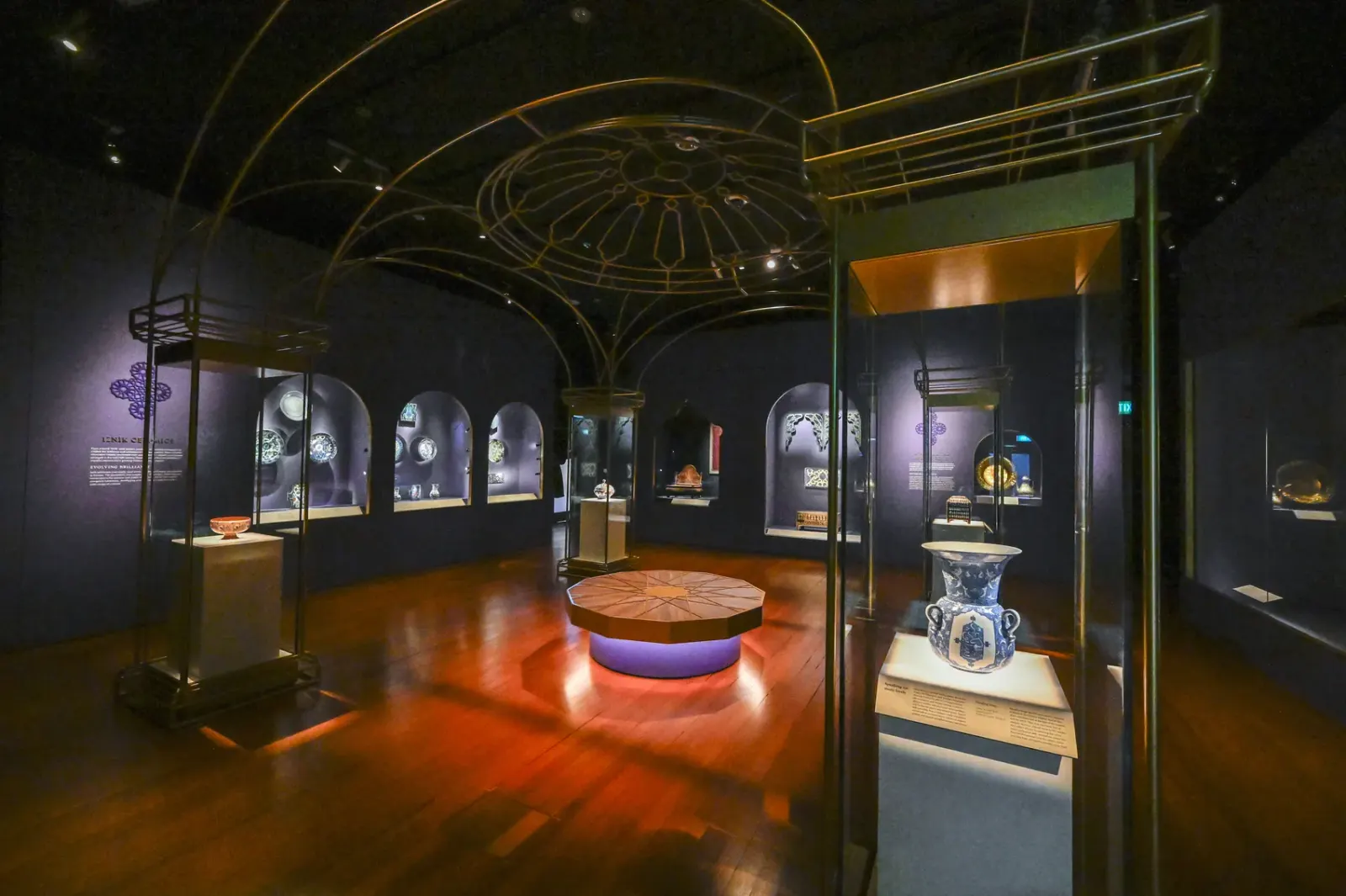
The Ottoman world and its provinces
ISTANBUL · IZNIK · CAIRO · DAMASCUS
Responding to imported Chinese porcelain, Ottoman potters developed a vibrant palette and decorative vocabulary of their own. Some ceramic forms drew on contemporary metalwork too — ideas moving not only across regions, but between mediums.
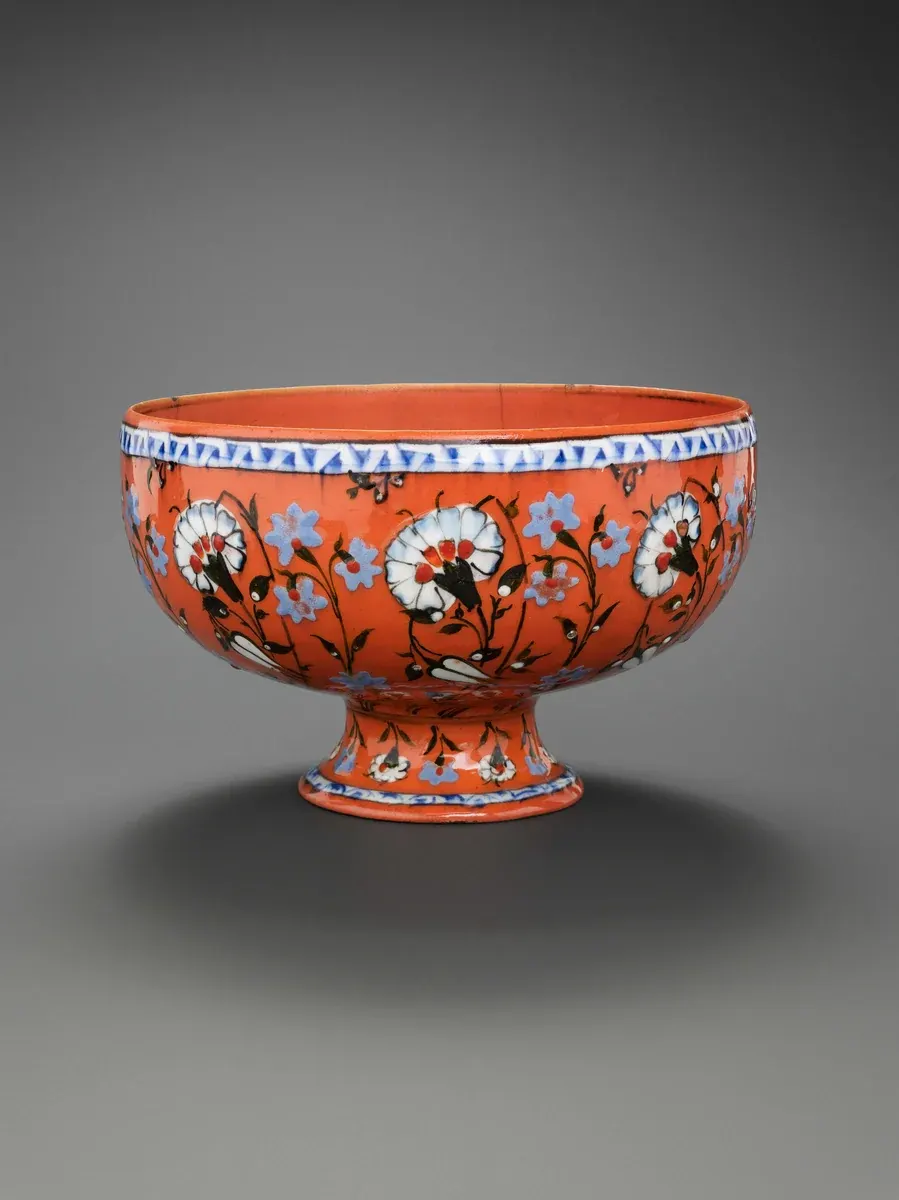
Bowl
A coloured slip — a quartz-rich mixture — covers the surface of this bowl, giving it its distinctive pink to coral tone. Bowls of this type emerged in the mid-16th century, marking a mature phase in Iznik production. Fully intact examples are rare, though many fragments have been found in excavations at Iznik. Carnations and tulips repeat in gently curving sprays, likely applied using a stencil.
Bowl. Turkey, around 1560 – 75. Glazed ceramic. Bequest of Piet-Lataudrie, 1909. Department of Islamic Art, OA 6325 © 2009 Musée du Louvre, Dist. GrandPalaisRmn / Hughes Dubois
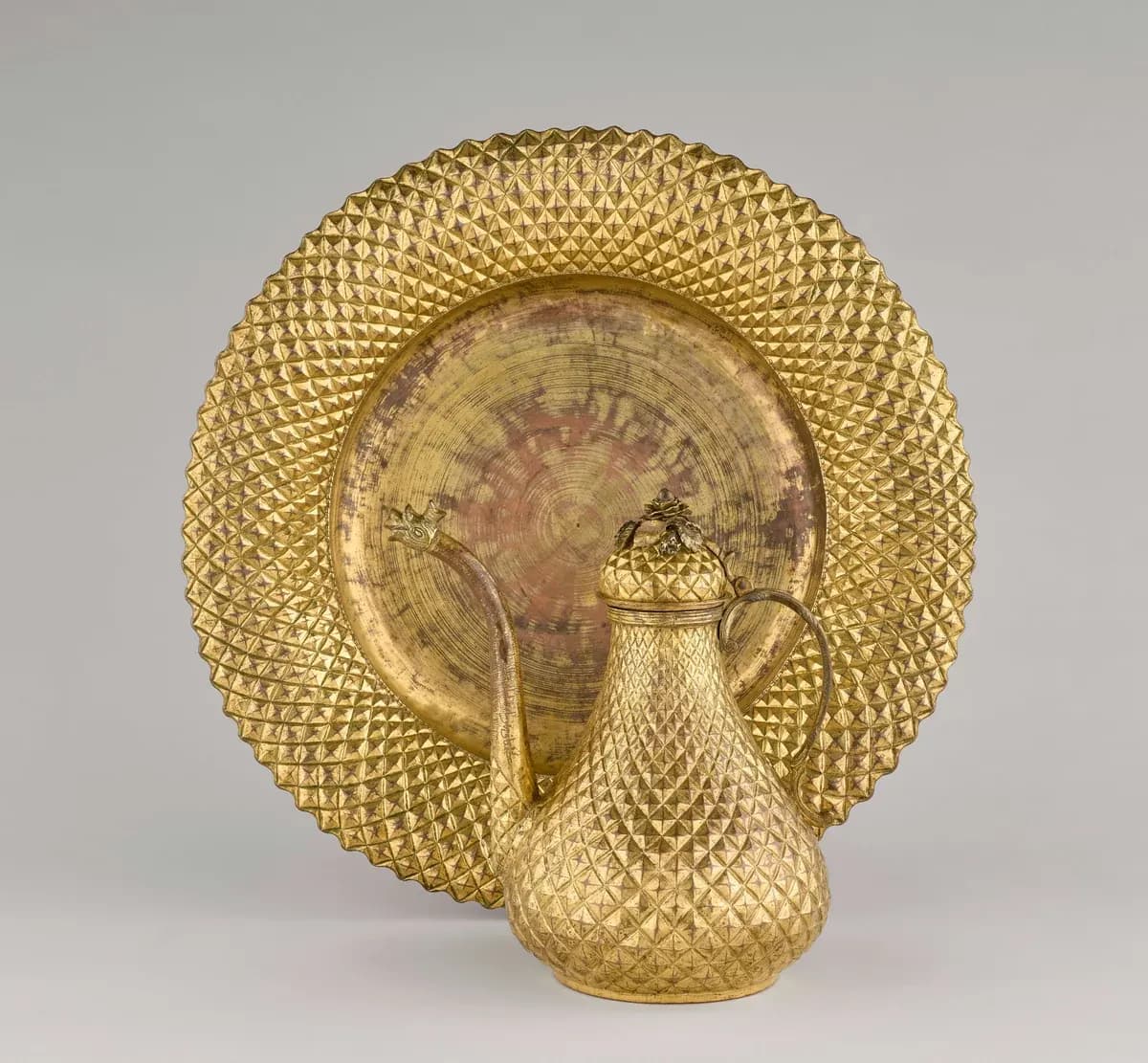
Ewer and basin
Engraved on both ewer and basin is the name of Mihrimah Sultan (1812–1838), daughter of Sultan Mahmud II. The inscription bears an Islamic (Hijri) date corresponding to 1820–21 — she received this set at the age of eight, while living in the imperial harem. Such sets were used for handwashing and ritual ablutions, and often bear ownership marks that trace patterns of patronage and taste.
Ewer and basin. Turkey, 19th century. Gilded copper. Department of Islamic Art, RFML.AI.2022.24-1, 2 © 2024 Musée du Louvre, Dist. GrandPalaisRmn / Stéphane Maréchalle
Level 3 · Design Gallery
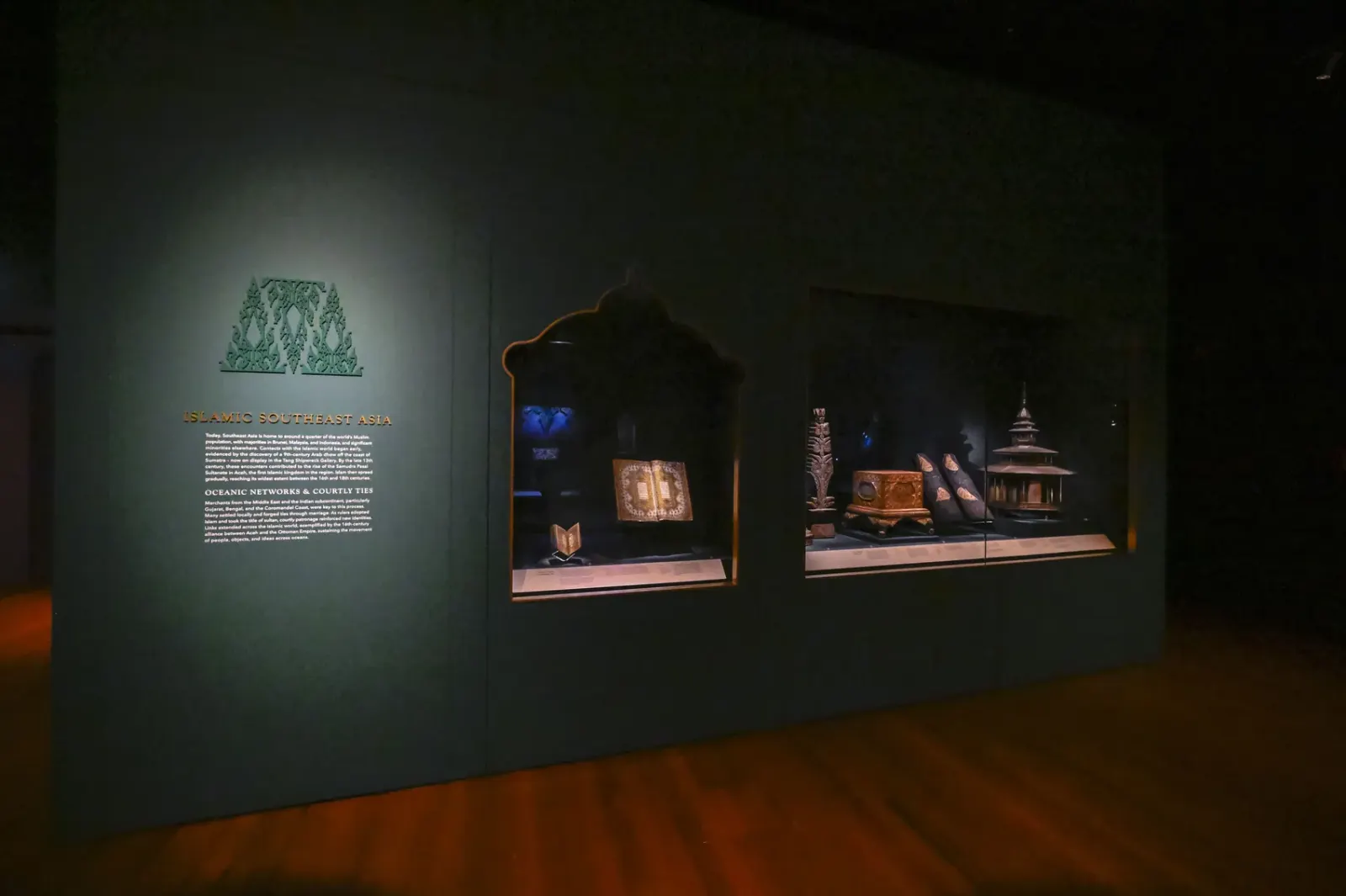
Islamic Southeast Asia
OCEANIC NETWORKS & COURTLY TIES
Southeast Asia remains underrepresented in global narratives of Islamic art, despite the region’s long and rich history of exchange with the wider Islamic world. This is the strand of the show that answers that — and the one you may recognise.
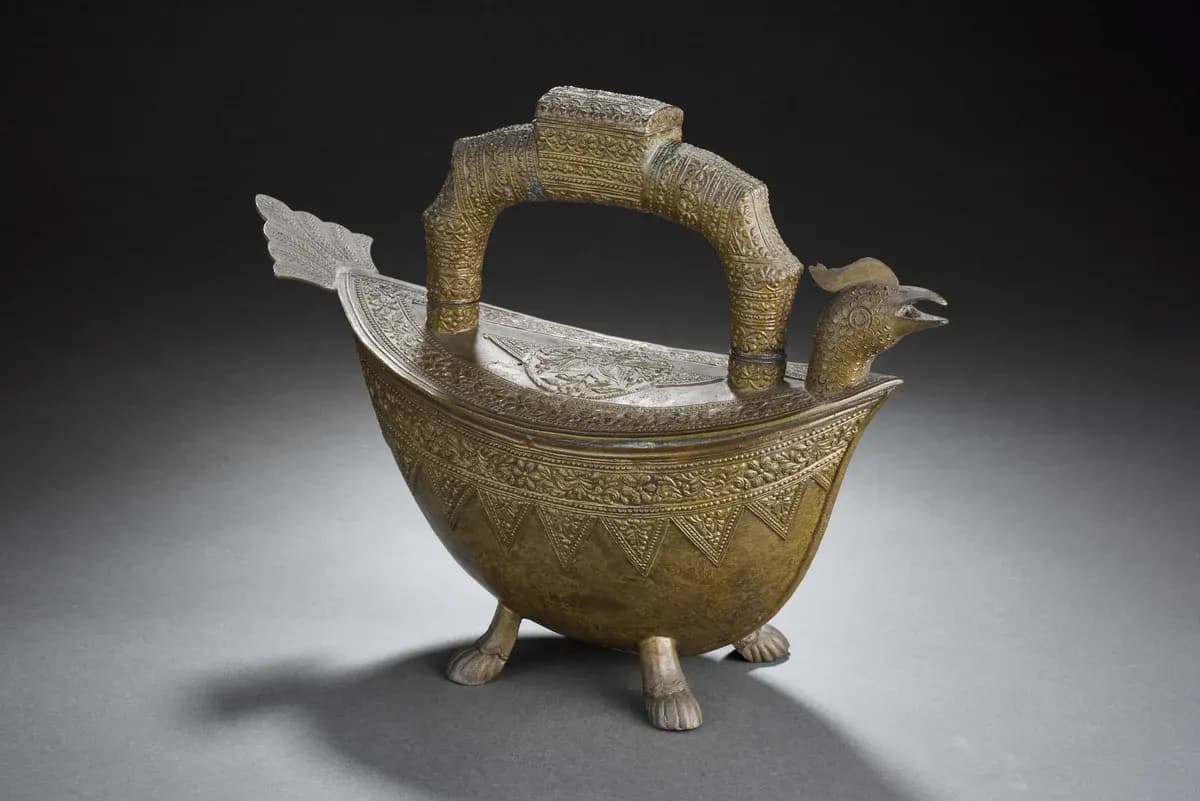
Ewer
Made by Minangkabau people of West Sumatra, this ewer demonstrates how artistic ideas travelled across the Indian Ocean and took on new forms in Southeast Asia. Its shape derives from the Persian aftaba, a vessel associated with ritual purification and the practice of adab (etiquette) — yet local craftsmen transformed the design with distinctive details of their own, including a bird-shaped spout and animal-shaped feet.
Ewer. Image Courtesy of Asian Civilisations Museum.
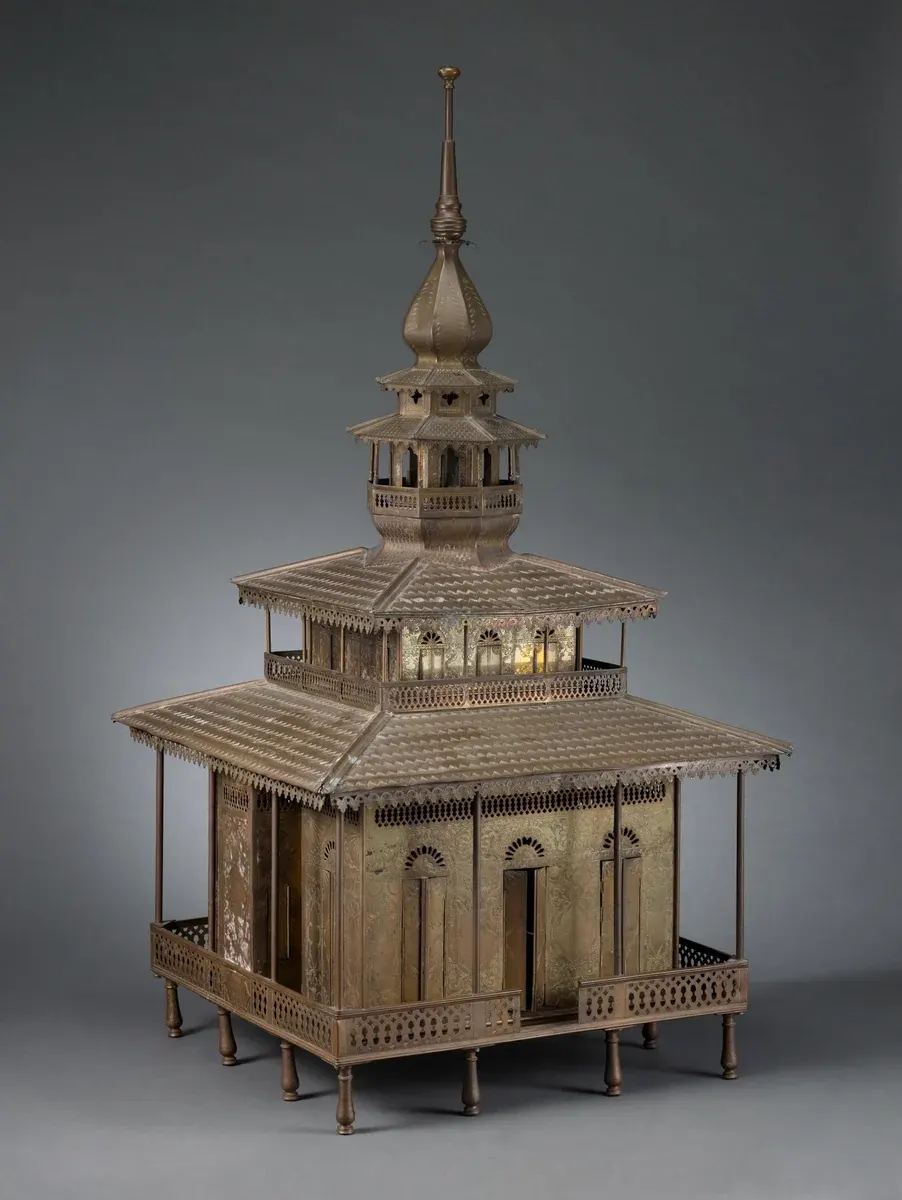
Mosque model
This model reflects the mosque architecture of the Minangkabau people in West Sumatra. Its square plan contrasts with the rectangular layout of traditional houses, marking sacred space, while the towering roof establishes the mosque as the most prominent feature of the landscape. The multi-tiered roof is regional — but the crowning dome, adopted in West Sumatra in the late 19th or early 20th century and influenced by Mughal or Ottoman architecture, signals a cosmopolitan Islamic identity. An inscription on the base records the name of the commissioner.
Mosque model. Image Courtesy of Asian Civilisations Museum.
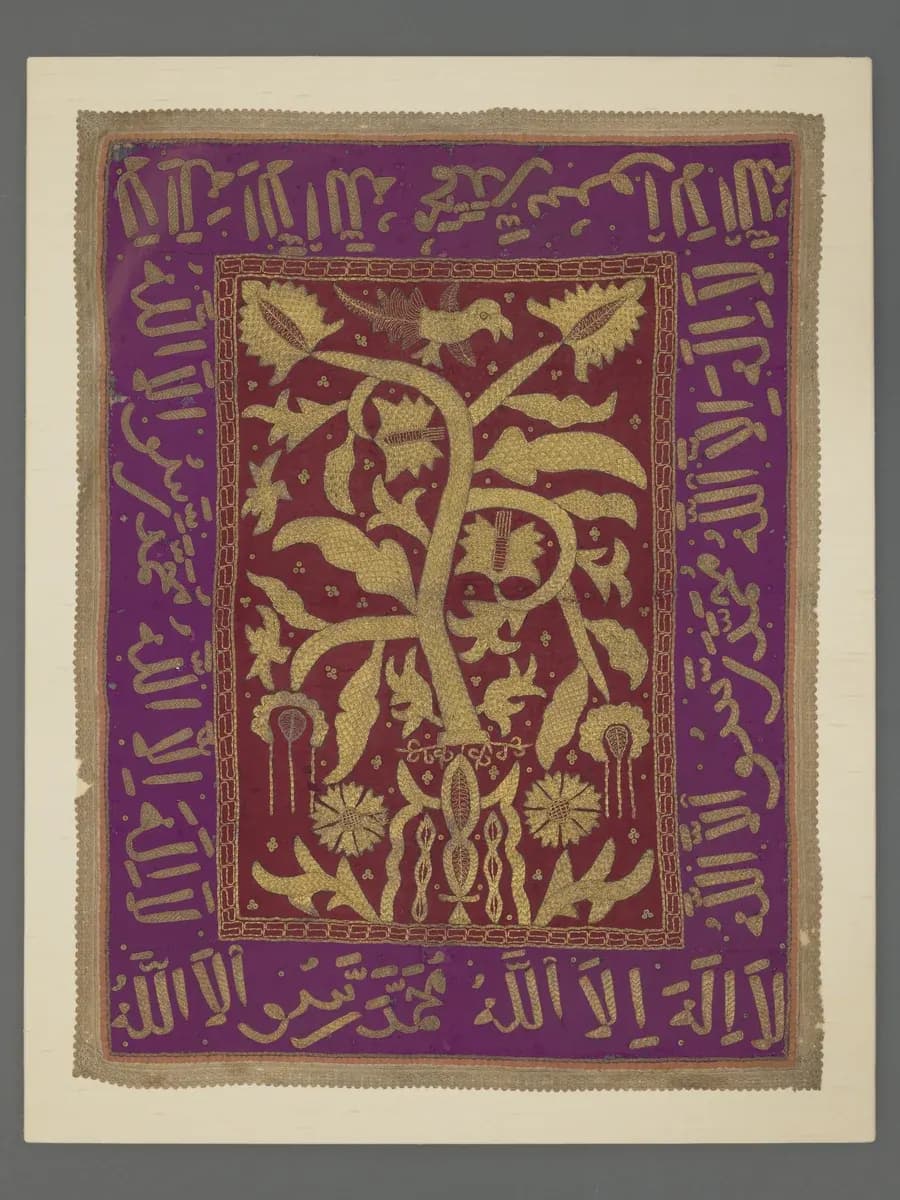
Hanging with tree-of-life
A recurring motif in the visual cultures of island Southeast Asia, the tree of life draws on multiple traditions to express ideas of cosmic order. It resonates in both Islamic and pre-Islamic contexts — as the pohon budi, the bodhi tree, and as the pauh janggi, a mythical tree in Malay lore believed to connect the earth and the heavens. Hangings like this were used in important social ceremonies, including weddings. The design is strikingly similar to Indian trade textiles of the 18th century, and was likely modelled on those imports.
Hanging with tree-of-life. Image Courtesy of Asian Civilisations Museum.
The Onz take
Worth your Saturday?
Normally you’d have to fly to Paris to see these. A hundred pieces from the Louvre are sitting at Empress Place until January 2027 instead, and that on its own is worth the trip down.
What makes it more than a nice day out is what ACM did with them. They didn’t put the Louvre on one side and us on the other. They slipped thirty of their own Southeast Asian pieces in among the loans — so you keep spotting our part of the world inside a story that usually leaves it out. It changes how the Louvre pieces look, too.
Three things to look for:
- A brass jug from West Sumatra. The shape is Persian. A local maker gave it a bird’s head for a spout.
- A small brass mosque, also from Sumatra. Look at the dome on top — domes weren’t a local thing. Someone added it to say: we’re part of a bigger Muslim world.
- A gold-embroidered cloth from Aceh. The pattern copies Indian textiles that traders had been bringing over for a hundred years.
Sort art by empire and none of that shows up. Put the pieces next to each other and you can’t miss it.
Two floors, a hundred and thirty objects — a lot for one visit. It’s free if you’re Singaporean or PR and it runs to January 2027. Only got an hour? Head straight up to Level 3, where most of the Southeast Asian pieces are.
Go if
You want to see world-class pieces without buying a plane ticket. Or you just like knowing that a jug made in Sumatra started out as a Persian design.
Know before you go
It’s a quiet show. Small objects, low lighting, a lot of detail up close. Give it time and it pays you back; rush it and you’ll miss the point.
Onz or not? Let’s go!
- When
- 19 June 2026 – 24 January 2027
Daily 10am – 7pm
Fridays 10am – 9pm
- Where
- Asian Civilisations Museum
1 Empress Place, Singapore 179555
Raffles Place MRT
- Cost
- Free entry for Singaporeans and PRs.
- Which floors
- Islamic Art Gallery, Level 2. Then Design Gallery, Level 3.
Exhibition dates, gallery titles, object descriptions and captions follow the information published by the Asian Civilisations Museum. Images supplied by ACM and reproduced with their credit lines in full. Onz is not affiliated with ACM, the National Heritage Board or the Musée du Louvre. Admission fees are subject to change — confirm on ACM’s own site before you travel.