
Run Clubs in Singapore: How to Join Your First One (and What Shoes to Wear)
Free, social and starting near an MRT after work: what a first run club night is really like, the one number you need, the shoe questions nobody admits to asking, and the clubs that suit your pace.
By Onz Editorial · edited by Shawn Liu · 22 October 2026
The secret nobody tells you about run clubs: almost nobody there is as fast as you fear. Turn up at 7pm on a weeknight near your office and you’ll find a crowd split into pace groups, a pacer out front, someone sweeping at the back so nobody gets left, and a supper plan that matters at least as much as the run.
And most of them cost nothing. Here’s what a first night is actually like, the only number you need to know, what to put on your feet, and the clubs that suit where you are and how fast you go.
What a first run club night is actually like
You find the meeting point, drop your bag, and someone runs a warm-up that you will half-follow. Then the crowd splits by pace: each group has a leader holding a steady speed, so you just tuck in and talk. Most weeknight runs are 5 to 10km. Then the real reason half the people came: kopi, supper or breakfast after.
The bit that surprises first-timers is how organised it is. The big clubs post each week’s meeting point on Telegram, some ask you to RSVP so they know how much water to buy, and a few scan you in on an app. None of the clubs below charge to run with them.
One Singapore-specific thing: in haze season, clubs make a go or no-go call before each run. When the haze turned unhealthy in October 2026, nearly every club cancelled between about 9 and 17 October, and the calls went out on their Telegram channels hours before the start. Follow the channel before you follow the club.
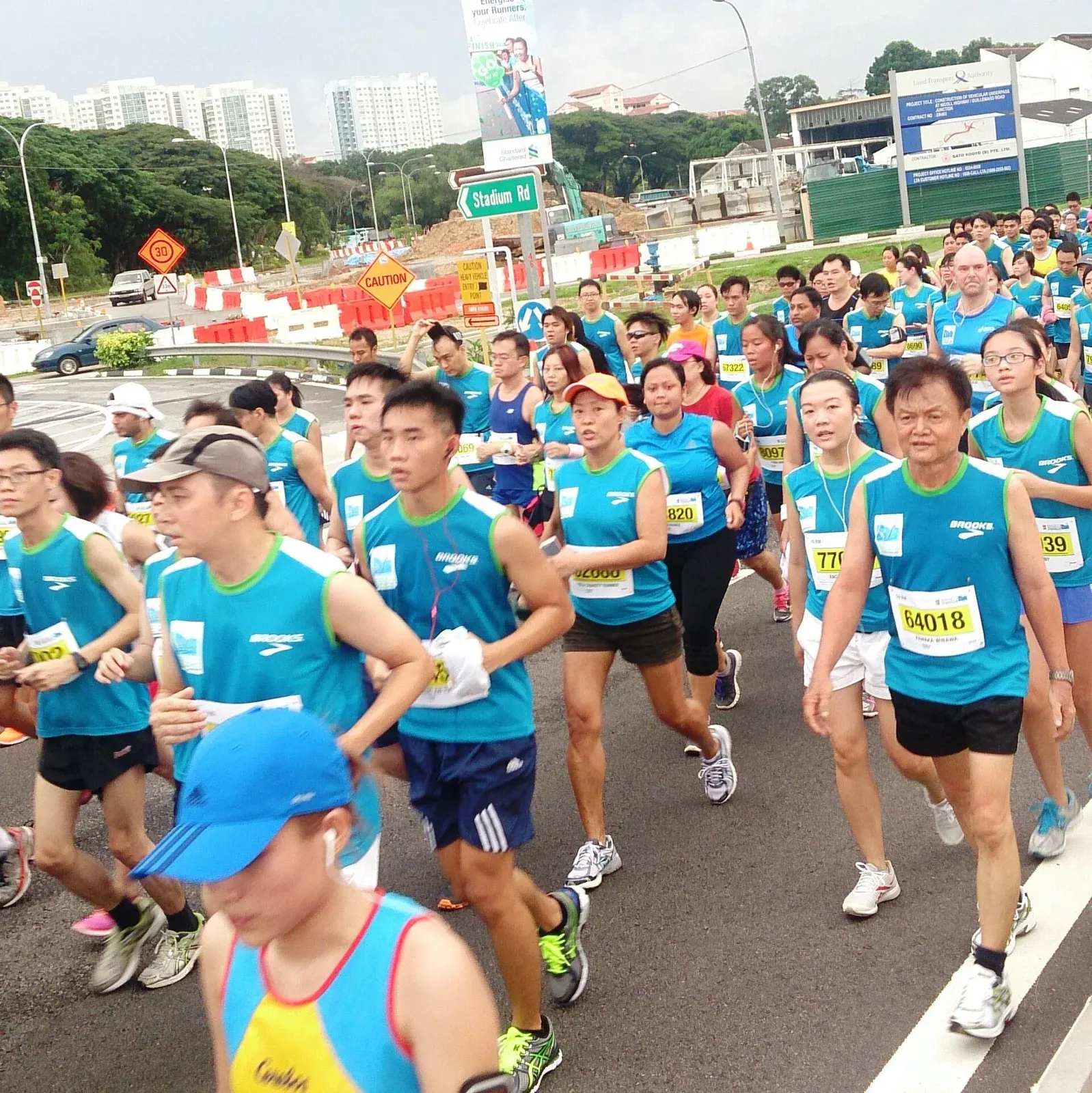
Photo: ProjectManhattan, CC BY-SA 3.0, via Wikimedia Commons
Know your pace: the only number you need
Clubs describe groups in minutes per kilometre: “6:30” means six and a half minutes for every kilometre. Lower is faster. If you’ve never timed yourself, start in the slowest group on offer. Several clubs below run groups at 7:00 to 8:00 min/km, which is a comfortable, talking pace for most new runners. Moving up a group next month is the fun part.

Photo: Sgconlaw, CC BY-SA 4.0, via Wikimedia Commons
Heat, haze and rain
Singapore’s heat advisory uses a heat-stress reading called WBGT, in three bands: low below 31°C, moderate from 31°C (cut back, rest more, drink more) and high from 33°C (keep outdoor activity to a minimum). The reading for your nearest sensor is on the myENV app and weather.gov.sg. It’s why so many clubs run at 7pm or before 7.30am.
For haze, HealthHub’s guidance is that when the 24-hour PSI is 101 to 200, healthy people should reduce prolonged or strenuous outdoor exertion, and above 200 they should avoid it; the one-hour reading is the one to check before a run. Rain is simpler: heavy rain or lightning usually means a cancellation post.
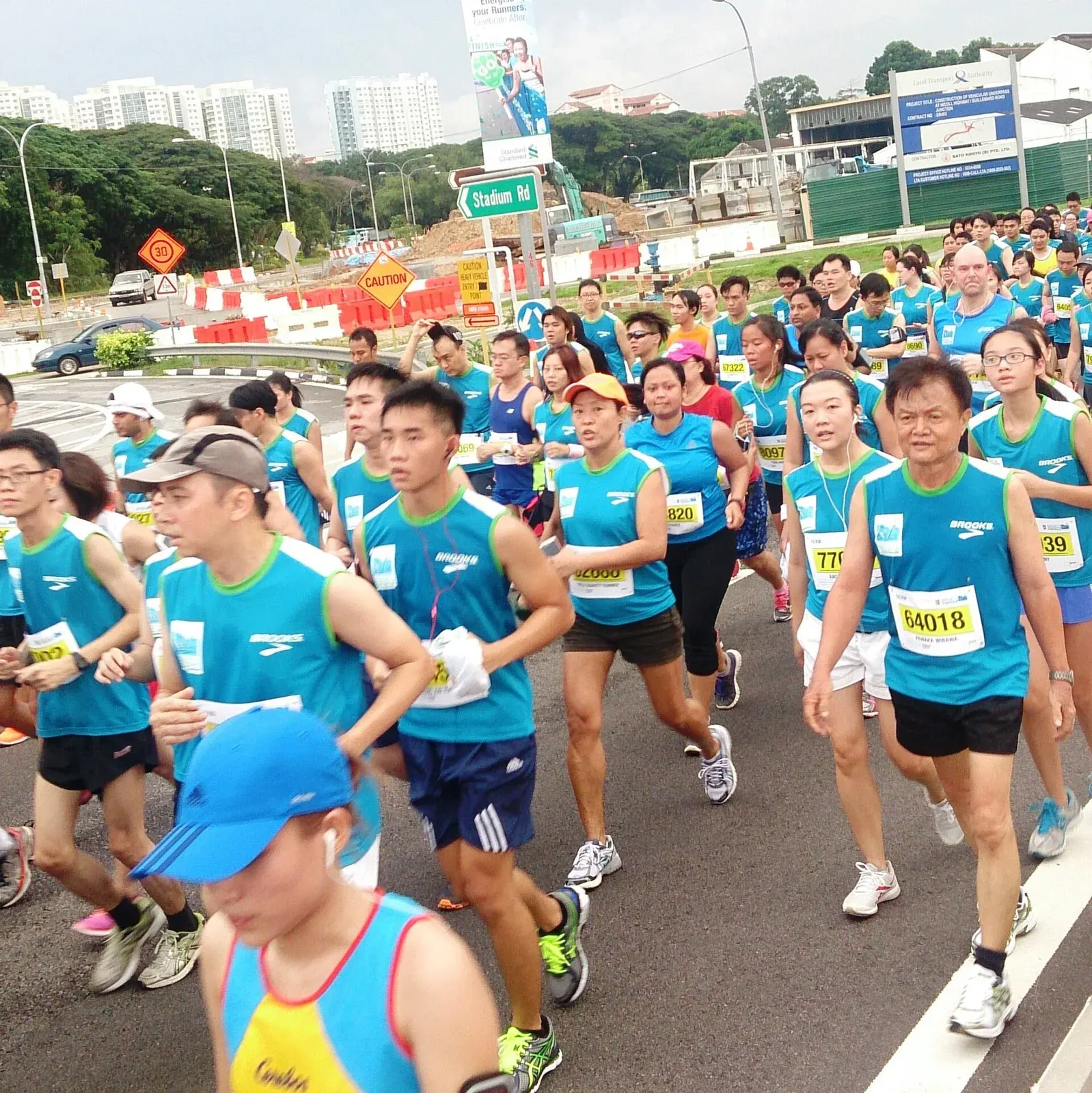
Photo: ProjectManhattan, CC BY-SA 3.0, via Wikimedia Commons
Which shoes do you actually need?
Less than the shop wall suggests. For most people starting out, a comfortable, cushioned everyday running shoe (a “daily trainer”) does the job. A 2015 review in the British Journal of Sports Medicine argued that the best evidence-based filter is simply comfort: pick the pair that feels right when you run in it.
Daily trainers are neutral, cushioned shoes for most runs. Stability shoes add support for feet that roll inwards (overpronation), but a year-long study of 927 new runners in neutral shoes found that pronated feet were not more likely to get injured, so don’t let anyone sell you correction you don’t need. Max-cushion shoes are the softest and bounciest. Carbon-plated racers are for fast race days: in a 2018 lab study they cut energy cost by about 4% at fast paces, and doctors who saw midfoot stress injuries in some users suggest easing into them gradually. Trail shoes have grippier soles, and MacRitchie’s roots get slippery after rain.
Three Singapore notes. Breathable uppers matter in this humidity. Try shoes on for width, not just length. And you don’t need to change how your foot lands: a 2017 review found switching from heel-first to forefoot running doesn’t make you more efficient or less likely to get hurt. As a rule of thumb, running shoes last about 480 to 800km, and the midsole goes before the shoe looks worn.
Photo: elfgoh., CC BY-SA 2.0, via Wikimedia Commons
Where to run when there’s no club tonight
ActiveSG’s favourites: East Coast Park, about 10km out and back from Marine Cove, flat with water coolers (Marine Parade MRT); MacRitchie Reservoir’s 11 to 12km trail loop from the Visitor Centre, with the TreeTop Walk on the way; and the Southern Ridges from Henderson Waves, with stairs to earn your breakfast. NParks’ Punggol Waterway route gives you 8.4km along both banks. Singapore had 391km of park connectors at the end of 2024, so there’s probably one near you.
The clubs, by what you’re after
Schedules shift, especially after marathon season and around haze, so check each club’s channel on the day. Everything below was checked against the clubs’ own channels on 22 October 2026.
If you’re new or slow (and proud of it)
Slowflo Run Club — Thursdays 7pm at National Stadium Gate 2, workouts at easy paces, plus weekend social and café runs and the occasional gentle trail outing. RSVP by Telegram poll; dinner after.
Big Boyz Run Club — Sundays 7.30am at rotating heartland spots: Jurong Lake Gardens, Waterway Point in Punggol, Pasir Ris Park and Anchorvale Village in Sengkang. A run club that, by its own description, doesn’t run very fast. Breakfast after; just turn up.
Easy Pace Run Club — explicitly non-competitive. Its regulars have been Thursday-evening easy 5Ks and Saturday-morning distance runs, and it’s running special events this month. Register for each run at easypaceonly.com.
parkrun — a free, timed 5km every Saturday morning at East Coast Park, West Coast Park, Bishan–Ang Mo Kio Park, Bedok Reservoir Park, Bay East Garden and Jurong Lake Gardens. Walkers welcome; register once and bring your barcode.
If you want a big, social after-work run
Running Department — Wednesdays 7.15pm at a rotating CBD or Kallang spot, 5km or 10km, with pace groups from about 5:00 to 7:30 min/km. Free; scan in with the Healthy 365 app for bag drop and water. Saturday long runs need registration.
Running Lab Community Run — Wednesdays, bag drop from 7pm at the Marina Square outdoor plaza, pace groups from 5:00 to 8:00 min/km. Free, but register for each run on Eventbrite; water and bag drop provided.
Urban Milers — a Wednesday 7pm CBD run roughly every fortnight, plus some Saturday mornings. RSVP by Telegram poll so they can order water.
adidas Runners Singapore — Saturdays 7am, coached, with pacers. Sign up and check in on the adidas Running app. The meeting point moves with their training blocks, and there’s no water station, so bring a bottle.
If you’re training for something
Fast and Free Running Club — Thursday workouts with drills at 7.15pm at The Kallang (Gate 4), and Saturday 13 to 16km long runs from 18 Robinson Road at 6.45am, with pace groups from 5:30 to 7:15 min/km. Free; join their Telegram. Saizeriya after Thursdays, kopi after Saturdays.
Women-only
Running Department’s RD Pop-Up — Saturday 7am runs at East Coast Park’s Parkland Green, 6 to 18km.
Beyond Miles Club — its “Beyond Her Miles” run is a 5km on Wednesdays at 7pm from Gardens by the Bay; sign up on Eventbrite. Expect music and a big crowd.
Questions, answered 🤔
Are run clubs in Singapore free?
Most are. Running Department, Running Lab, Fast and Free, Slowflo, Big Boyz and parkrun cost nothing to run with; some ask you to register for each run (on Eventbrite or an app) so they can plan water and bag drop.
I’m slow. Will I be left behind?
No. Clubs split into pace groups, and several run groups at 7:00 to 8:00 minutes per kilometre, a comfortable talking pace. Many also have a sweeper at the back. Start in the slowest group and move up when you’re ready.
Do runs go ahead in the haze?
Not when it’s bad. Clubs check the PSI and post a go or no-go call on their channels before each run. HealthHub advises healthy people to reduce prolonged or strenuous outdoor exertion when the 24-hour PSI is 101 to 200, and to avoid it above 200.
Do I need special running shoes to start?
A comfortable, cushioned everyday running shoe is enough for most beginners. Research suggests choosing by comfort works better than buying correction you may not need, and you don’t need to change how your foot lands.
Don’t say we bojio 📬
Reads like this + the week’s best events, every Thursday.
Not an email person? Follow @onzsg on Telegram — two good picks a day, straight to your phone. 📣